

Description
SynthForSale proudly features Synths & Workstations, a name synonymous with quality. The Behringer Crave Analog Semi-Modular Synthesizer with 32-step Sequencer stands out as a refined and capable piece of gear, designed to inspire.
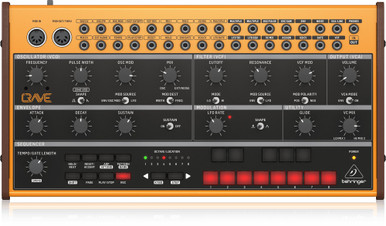
Introducing the Behringer Crave, an ultra-compact analog monosynth with a 3340 VCO, 32-step sequencer, 18×14 patch points and way more. Another original design from Behringer to sit alongside the Neutron, the Crave promises ultra-fat sound, killer flexibility and hours of sonic exploration – what are you waiting for?
Key features
- Analog synthesizer with legendary Prophet 5 VCO design allows for massive sounds
- Pure analog signal path based on authentic VCO, VCF and VCA designs
- Super-rich oscillator with pulse and sawtooth wave outputs
- Moog-style 24dB ladder filter with resonance for warmth and dynamic sound
- Switchable low/high pass filter mode
- Modern and easy-to-use 32-step sequencer with 64 onboard storage slots
- Advanced Arpeggiator with wide patterns for great sound effects
- Dedicated and fully analog triangle/square wave LFO
- 16-voice Poly Chain allows combining multiple synthesizers for up to 16-voice polyphony
- Semi-modular design with default routings requires no patching for immediate performance
- 18 x 14 I/O matrix for incredibly vast and flexible patching options
- Noise generator dramatically expands waveform generation
- 47 controls give you direct and real-time access to all important parameters
- External audio input for processing external sound sources
Classic oscillator and filter design
The Crave is an original design from Behringer, combining the best of both worlds. By this, we mean that it’s a compact desktop synth with an intuitive sequencer/arpeggiator, and a semi-modular toolkit with a sound that’s inspired by the classics.
The 3340 VCO uses the same design as the legendary Dave Smith Prophet 5, known for its ultra-fat response. The 24dB ladder filter is based on the classic Moog filter – seen by many as the definitive filter sound. By combining these two borderline-iconic components with a simple interface and extensive controls, Behringer have produced an undeniably powerful synth with a crazy price tag.
Semi-modular for the masses
15 knobs provide plenty of control without over-complicating matters. The VCO controls let you switch from square to saw, add external audio/noise to the mix, tweak the pulse width and more. The VCF and envelope controls are familiar territory, with a 2-shape LFO to add some movement.
It’s the extensive patching that kicks the Crave up a gear or two. Reroute the LFO modulation, modulate pulse with MIDI gate signals – all of the above. Combined with a 32-step sequencer, this little thing can go from 0 to berserk in no time – a brilliant exploratory synth with an entry-level price tag.