
Description
Here's What Studio Electronics Say About the Boomstar 4072
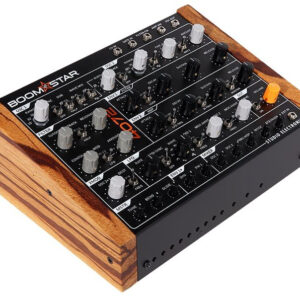
Boomstar is a return to the raw power and purity of non-programmable discrete analog, where STUDIO ELECTRONICS started in 1985 with the Midimoog. The snap and punch of hardware envelopes drive the Boomstar's brilliant discrete voltage controlled circuits with unparalleled sonic integrity and versatility; refaced, and revoiced for 2018, the Boomstar MKII is likely the ultimate desktop analog synthesizer for those who remember, and desire still, analog synth sounds that changed the music, and sound seekers who have yet to discover that electric magic and delight in their time—via MIDI or CV of course.
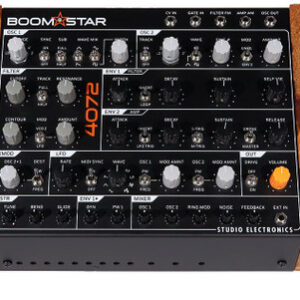
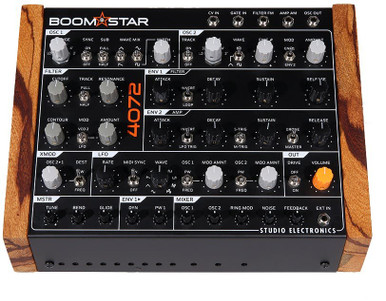
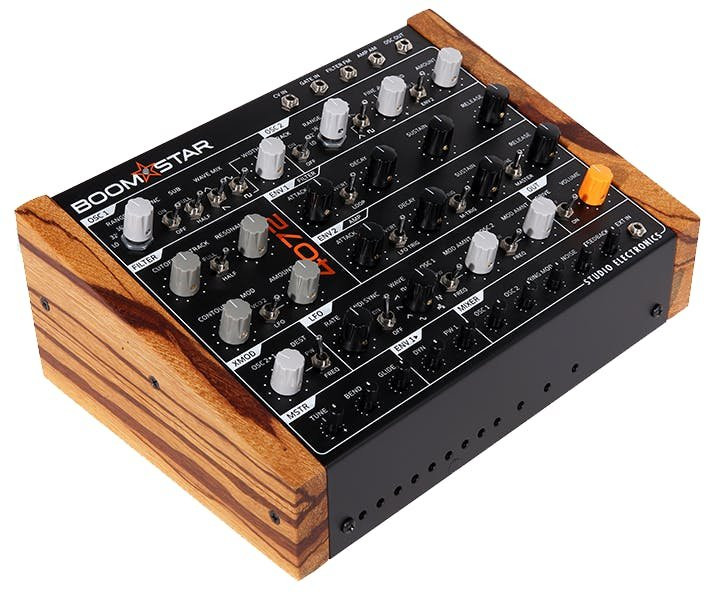
The Boomstar's alchemy of combinable waveform oscillations—with sub, OSC1-OSC2 sync—filter and oscillator xmod, ring mod, 5 revered filter types, extensive modulation routing made easy via its 18+ toggle switches, and a flexible software LFO, make sound and music design a daring delight. Hardware envelopes with invert, loop, drone and master mode deliver that flexible, funky snap and shift.
The quick-turn shaft pots along the bottom for the hardware ring mod, noise, feedback: now diode-based for more complex and interesting harmonic distortion, and VCO Levels make vital sonic changes intimate, immediate, and indispensable; the adjacent overdrive switch adds beefy boost, warmth, and edge. 29+ pots insure a fluid, intuitive groove over wide-ranging sweeps, and subtle tone variations: whip them suddenly and rhythmically into shape, or feather in the changes.
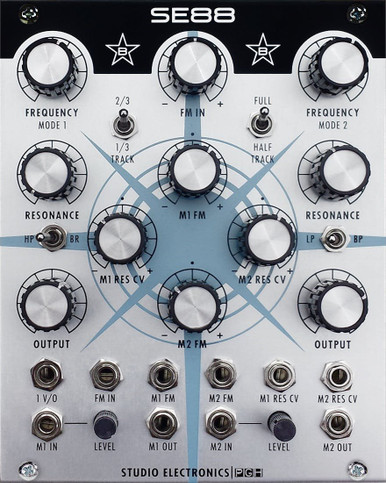
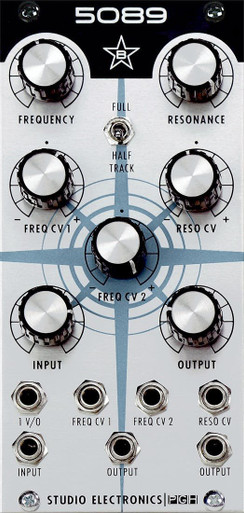
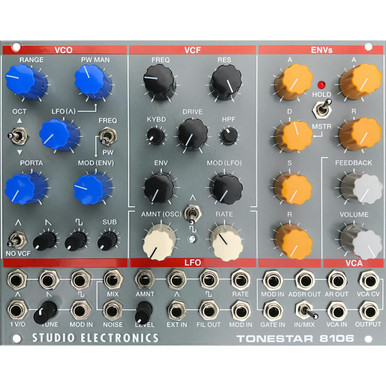
Expect cleaner levels in and out of the 6 MKII filter models for 2018 (MKIIs will still brown out but their headroom is more generous): 3003—rubbery, squelchy, twangy, lo-fi, beloved Roland® TB-303 (not pictured), 4072—powerfully resonant, thumpy and mid-rangy ARP® 2600; 5089—classic, buttery & boomy Moog® 24dB ladder; 8106—ripping Jupiter-Juno Roland® magic; SEM—the original Lord Tom Oberheim® 2-pole 12dB/octave, boxy, reedy & boomy gem; SE80—the legendary, creamy, dreamy, multi-mode Yamaha® CS-80. So why not go off-synth via the external input processing patch point: connect rhythm and color to non-native oscillations and pulses, moving in, around, and through them?
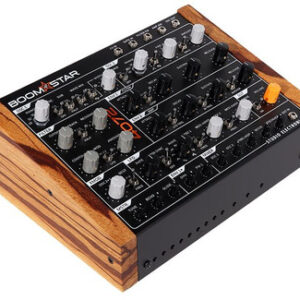
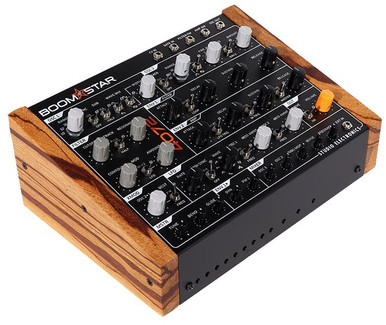
SidesExoticia® Bocote, Marblewood, Pau Ferro, and East Indian Rosewood end bells, are hand selected, handcrafted one-offs, and will vary greatly in grain and attractive imperfections, but they are always character rich, and easily transcend exact appearance expectation. Expect a richly figured hardwood. Bocote and Marblewood are "CITIES" compliant; Indian Rosewood is USA only.
Can't decide which model deserves your attention? It does help that Boomstar is a discrete, through-hole, hand-matched transistor, semi-modular desktop monophonic synthesizer, built in the U. S. A. to last, no matter which glowing circuit, handcrafted filter model you choose—the 1st time.
Boomstar 2018 Highlights
- Refaced for clarity of function, signal flow and an overall visual/tactile assist.
- Revoiced for purity of tone—more headroom into amplifier; browning-out is delayed.
- Diode-based feedback circuit for greater dynamic range and harmonic distortion content.
- Exotic and rugged hand-picked and handcrafted lumber/microlumber sides
- Lined, fluted knobs and lined quick-turn pot shafts top and bottom for more precise programming and patch recall.
- Metal-shafted pots installed throughout, apart from the envelopes, where the custom taper plastic-shafted pots are strengthened with an added bushing.
Specifications
Construction
- Sturdy steel chassis, 29-31 pots, 2 rotary switches, 18-19 toggle switches—15 three way for expanded functionality—AC power triple output desktop adaptor (15, -15 Volt Auto-Switching Supply). Tried and true through-hole technology—not surface mount—for integrity of sound quality, durability, and serviceability.Dimensions
- Height: 2.05" (52.07 mm) at front, 3.625" (92.075 mm) at back, Width: 8.7 " (220.98 mm), Depth: 7.05" (179.07 mm).
Sound Generation
- All discrete circuity, with the exception of the software LFO. Hand matched transistors in filter and amplifier.
Oscillator 1
- 6 position rotary range switch; Two center off toggle switches select combinations of sine, triangle, saw and square waveforms; Pulse width for square waveform; Sub oscillator with center off toggle switch for half and full level positions; Sync oscillator 2 to oscillator 1 switch.
Oscillator 2
- 6 position rotary range switch; Three position toggle switch to select triangle, saw or square waveform; Fine tune pot; Mod depth pot with center off toggle switch to select modulation by envelope 1 or 2; Keyboard tracking on-off switch.
Filter / Envelope 1
- Frequency and resonance pots; Center off toggle switch to select half and full keyboard tracking; Envelope mod depth pot; Additional mod depth pot with center off toggle to select modulation by oscillator 2 or the LFO. Envelope 1: Attack, decay, sustain, and release pots; Center off toggle switch to select envelope invert or envelope loop.
Filter Types
- 3003—resonant low-pass, diode ladder, 4-pole 24 dB/octave (Roland® TB-303); 4072—resonant low-pass, 4-pole 24 dB/octave—12 kHz design miscalculation corrected—(ARP® 2600); 5089—resonant low-pass, transistor cascade ladder, 4-pole 24 dB/octave (Moog® Model D); 8106—multi-mode non-resonant high-pass, resonant low-pass, 4-pole 24 dB/octave (Roland® Jupiter8); SEM—multi-mode resonant low‑pass/high‑pass, band‑pass and notch, 2-pole 12 dB/octave (Oberheim®); SE80—dual resonant hi-pass/low-pass, 2-pole 12 dB/octave (Yamaha® CS-80).
Envelope 2
- Attack, decay, sustain, and release pots; Center off toggle switch to select envelope invert or LFO gate trigger; Single or multiple triggering switch; Center off toggle switch to select drone and envelope 1 as master. With master selected, envelope 2 is the modulator for both the amplifier and filter frequency. Envelope 1 remains active for oscillator 2 frequency and oscillator 1 pulse width modulation.
XMod
- Oscillator 2 mod depth pot with center off toggle switch to select modulation of oscillator 1 pulse width or oscillator 1 frequency.
LFO
- Rate pot; MIDI sync on-off switch; Waveform pot: sine, triangle, saw up, saw down, square, offset square 1 and 2, random and slew random waveforms; Mod depth pot with center off toggle switch to select oscillator 1 frequency or oscillator 1 pulse width; Mod depth pot with center off toggle switch to select oscillator 2 frequency or oscillator 2 pulse width.
Amplifier
- Center off toggle switch to select two levels of overdrive; Volume pot.
Tuning
- Master tune pot.
Bender
- Bend range pot.
Glide
- Hardware exponential glide time pot.
Dynamics
- (routes MIDI keyboard) Dynamics to filter frequency pot.
Envelope 1 to Pulse Width 1 (ENV1> PW1)
- (routes) Envelope 1 to Oscillator 1 pulse width pot.
Mixer – OSC
- Oscillator 1 level pot; Oscillator 2 level pot.
Mixer – Ring Mod
- Hardware Ring Modulator level pot.
Mixer – Noise
- Noise level pot.
Mixer – Feedback
- (routes the synth's output back through the filter) Feedback level pot.
Front Panel Jacks
- CV in, Gate in, Filter frequency modulation in, Amplifier modulation in, Oscillator out, External signal in.
Back Panel Jacks
- MIDI In, MIDI Out, 1/4" Audio out, Traveller input (SE80 model only), DC power input.
Back Panel Switches
- Learn switch: Selects MIDI channel.
Overflow Switch
- For chaining together multiple Boomstars together via MIDI overflow.